
Being told you have an ovarian cyst can feel alarming, but in the vast majority of cases, there is no cause for concern. In my clinic, I see women referred with ovarian cysts almost every week — and the conversation almost always begins with the same question: “Should I be worried?” The answer, in the overwhelming majority of cases, is no. Ovarian cysts are extremely common. Most women of reproductive age will develop at least one during their lifetime, often without ever knowing it. Understanding what they are, how they behave, and when they genuinely require attention can save a great deal of unnecessary anxiety.
What are ovarian cysts?
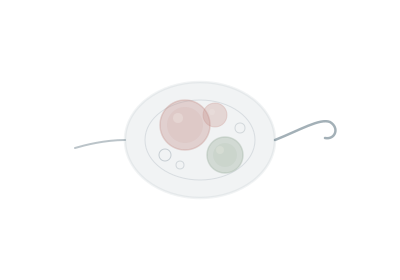
An ovarian cyst is simply a fluid-filled sac that develops on or within an ovary. The most common type, known as a functional cyst, forms as a normal part of the menstrual cycle. Each month, an egg develops inside a small follicle on the ovary. At ovulation, the follicle ruptures to release the egg. Occasionally, this process does not go entirely to plan, and a cyst forms instead. These functional cysts are not a sign of disease — they are a byproduct of healthy ovarian activity.
The first thing I reassure my patients about is that having a cyst does not mean something has gone wrong. The ovaries are dynamic organs, constantly producing and releasing eggs. A cyst is often simply a sign that the ovary is doing its job — just not quite completing one particular cycle as expected.
Types of ovarian cysts
While functional cysts are by far the most common, there are several other types that a gynaecologist may encounter. Each has its own characteristic appearance on ultrasound, and understanding the differences is important when it comes to deciding on management.
- Follicular cysts: These occur when the follicle does not rupture at ovulation and continues to grow. They are usually small and resolve within one to three cycles. I often describe them to patients as an egg that simply did not release on time.
- Corpus luteum cysts: After ovulation, the empty follicle normally shrinks. Sometimes it seals itself and fills with fluid, forming a corpus luteum cyst. These too are typically self-limiting and may occasionally cause a sharp one-sided pain that resolves within a few days.
- Dermoid cysts (teratomas): These unusual but benign cysts can contain tissue such as hair, skin, or even teeth. They develop from embryonic cells and tend to grow slowly over years. Dermoids are one of the most common cysts I see in younger women. Because they grow so gradually, many women have had one for years before it is picked up on an incidental scan. Although they are almost always benign, I generally recommend surgical removal if a dermoid is larger than five centimetres, because there is a small risk of ovarian torsion — the cyst can cause the ovary to twist on itself, which is a gynaecological emergency.
- Endometriomas: Sometimes called chocolate cysts because of the dark, old blood they contain, these form when endometriosis tissue attaches to an ovary. They have a very distinctive ground-glass appearance on ultrasound, which makes them relatively easy to identify. Endometriomas are associated with pelvic pain and fertility difficulties, and their management requires careful consideration — particularly in women who are planning pregnancy, because surgery on the ovary can reduce ovarian reserve.
- Cystadenomas: These develop from the surface of the ovary and can sometimes grow remarkably large — I have seen serous cystadenomas reach fifteen centimetres or more before causing enough symptoms to prompt investigation. They are usually benign but may require removal if they cause symptoms, continue to enlarge, or have features that are not entirely simple on ultrasound.
Symptoms: often none at all
Most ovarian cysts cause no symptoms whatsoever and are discovered incidentally during a routine ultrasound or examination. This is why many women are surprised to learn they have one. When symptoms do occur, they may include:
- A dull ache or heaviness in the lower abdomen or pelvis
- Bloating or a feeling of fullness
- Pain during sexual intercourse
- Changes in menstrual pattern
- A need to urinate more frequently if the cyst is pressing on the bladder
I always ask my patients to consider whether the symptoms are new, persistent, or progressive. Occasional twinges around the time of ovulation are common and usually not concerning. Persistent or worsening pain, on the other hand, warrants investigation.
When to worry
While most cysts are harmless, certain situations do warrant prompt medical attention:
- Sudden, severe pelvic pain: This may indicate that a cyst has ruptured or that the ovary has twisted on itself (ovarian torsion), both of which require urgent assessment.
- Large cysts: Cysts measuring more than 5 centimetres are more likely to cause symptoms and have a slightly higher risk of complications.
- Complex appearance on ultrasound: Cysts with solid components, internal septations, or irregular walls need further evaluation to exclude the rare possibility of malignancy.
- Cysts found after the menopause: Because ovulation has ceased, new cysts in postmenopausal women are not functional and may require closer investigation to exclude ovarian cancer.
How I assess ovarian cysts: ultrasound and the IOTA Simple Rules
The cornerstone of assessment is a transvaginal ultrasound, which provides detailed images of the ovaries and any cysts present. When I perform a pelvic ultrasound, I look for a number of specific features: the size of the cyst, whether it is purely fluid-filled or contains solid areas, the thickness and regularity of its walls, whether there are internal septations (dividing walls), and whether there is any blood flow within solid components.
To standardise this assessment, I use the IOTA Simple Rules — a validated classification system developed by the International Ovarian Tumour Analysis group. The IOTA system identifies five features that suggest a cyst is benign (B-features) and five that suggest it may be malignant (M-features). For example, a purely fluid-filled cyst with smooth walls and no blood flow has strong benign features. A cyst with irregular solid components, ascites, or significant internal blood flow raises more concern. In the majority of cases, the Simple Rules allow me to classify a cyst as almost certainly benign or potentially concerning without needing further tests. When the rules are inconclusive — which happens in roughly ten to twenty per cent of cases — I may refer for a specialist opinion or arrange additional imaging such as an MRI.
In some cases, a blood test for the tumour marker CA125 may be requested, particularly in postmenopausal women or when the ultrasound findings are not entirely straightforward. It is worth noting that CA125 can be raised by many benign conditions, including endometriosis, fibroids, and even menstruation, so it must always be interpreted in context rather than in isolation.
Management: my decision tree from reassurance to surgery
The approach to managing an ovarian cyst depends entirely on its type, size, ultrasound appearance, and whether it is causing symptoms. In my practice, I think of it as a decision tree with three main branches.
Watch and reassure. For simple functional cysts under five centimetres, watchful waiting is all that is required. I typically arrange a follow-up ultrasound after two to three menstrual cycles. In the vast majority of cases, the cyst will have resolved entirely, and no further action is needed. I explain to patients that this is not a passive approach — it is evidence-based management, because we know that the natural history of these cysts is to disappear on their own.
Scan again and monitor. For cysts that are persistent but have reassuring features on ultrasound — for example, a small dermoid or a simple cyst that has not changed over several months — I may recommend annual ultrasound surveillance rather than immediate intervention. This is particularly relevant for women who wish to preserve their ovarian tissue, such as those who are planning a pregnancy. Monitoring allows me to track any change in size or appearance over time and intervene only if the cyst grows, changes character, or begins to cause symptoms.
Operate. Surgery is recommended when a cyst is large (generally over five to seven centimetres), is causing significant symptoms, has concerning features on ultrasound, or is not resolving with time. Laparoscopic (keyhole) surgery is the standard approach and typically involves a short recovery period. In most cases, the ovary itself can be preserved — a procedure known as ovarian cystectomy. For very large or complex cysts, or in postmenopausal women, removal of the entire ovary (oophorectomy) may occasionally be the safest option.
Ovarian cysts in pregnancy
It is not uncommon for an ovarian cyst to be discovered during a routine early pregnancy scan. This understandably causes significant anxiety. The most common finding is a corpus luteum cyst, which is entirely normal in early pregnancy — it produces progesterone to support the pregnancy until the placenta takes over at around twelve weeks. These cysts almost always resolve by the second trimester without any intervention.
Occasionally, a pre-existing cyst such as a dermoid or cystadenoma is identified for the first time during pregnancy. In most cases, I recommend monitoring with ultrasound rather than intervening, unless there is a concern about torsion or the cyst is very large. If surgery does become necessary during pregnancy, it is safest in the second trimester, and laparoscopic techniques can be used in experienced hands. The key message I give to my pregnant patients is that most ovarian cysts in pregnancy are harmless and manageable, and the presence of a cyst does not in itself pose a risk to the baby.
When should you seek assessment? If you have been told you have an ovarian cyst, a specialist ultrasound assessment can provide clarity and peace of mind. I would particularly encourage you to seek review if the cyst is larger than five centimetres, if you are experiencing persistent pelvic pain, if the cyst was found after the menopause, or if you are planning a pregnancy and have an endometrioma. For general guidance, the RCOG offers helpful patient information leaflets.
Concerned about an ovarian cyst? Book a specialist assessment.
Book NowMedically reviewed by Dr. Victoire Kotur de Castelbajac, Medical Gynaecologist (GMC No. 7982441) — Last reviewed March 2026
Sources & Further Reading
- RCOG Patient Information — Patient leaflets on ovarian cysts from the Royal College of Obstetricians and Gynaecologists
- NHS: Ovarian Cysts — NHS patient information on ovarian cysts, types, symptoms, and management
- NICE Ovarian Cancer Guideline (NG61) — Guidance relevant to the assessment and surveillance of ovarian cysts