
Fibroids are one of the most common gynaecological findings — by the age of 50, up to 70% of women will have developed at least one. Yet despite how common they are, there remains significant confusion about when fibroids need treatment and what the options actually look like in 2026.
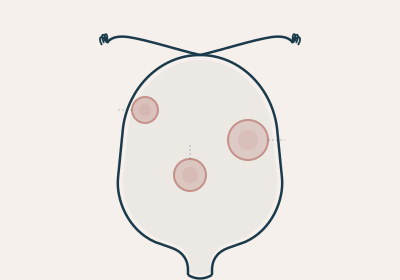
What are fibroids?
Fibroids (also called leiomyomas) are non-cancerous growths of the muscle wall of the uterus. They can range from the size of a pea to the size of a melon, and you can have one or many. Their location matters as much as their size — a small fibroid inside the uterine cavity can cause significant bleeding and iron deficiency, while a large one on the outer surface may cause no symptoms at all.
Types of fibroids: why location matters
When I discuss fibroids with patients, the first thing I explain is that not all fibroids are the same. Their position within the uterus determines which symptoms they cause and how urgently they need attention:
- Submucosal fibroids — these grow into the uterine cavity itself. Even when small, they are the type most likely to cause heavy menstrual bleeding and fertility problems. In my experience, a 2cm submucosal fibroid can cause far more trouble than an 8cm fibroid sitting on the outer wall.
- Intramural fibroids — the most common type, growing within the muscular wall of the uterus. They can enlarge the uterus significantly and cause heavy bleeding, pressure symptoms, or both, depending on their size and number.
- Subserosal fibroids — these project from the outer surface of the uterus. They tend not to affect menstrual bleeding but can cause pressure on the bladder or bowel, leading to urinary frequency or constipation.
- Pedunculated fibroids — either submucosal or subserosal fibroids that develop a stalk. Pedunculated submucosal fibroids can sometimes be removed hysteroscopically (through the cervix), which is a less invasive approach.
How fibroids are diagnosed
Transvaginal ultrasound is the first-line imaging for fibroids and is what I use in clinic as an initial assessment. It can identify fibroids, measure their size, and give a good indication of their position. For surgical planning — particularly if myomectomy is being considered — MRI provides a much more detailed map of fibroid number, location, and blood supply. I often request an MRI when there are multiple fibroids or when the ultrasound findings are complex, because the surgical approach depends heavily on this information.
Fibroids and ethnicity
This is a conversation I have regularly in clinic. Fibroids are approximately three times more common in Black women compared to white women, and they tend to develop at a younger age, grow larger, and cause more severe symptoms. The reasons for this disparity are not fully understood — genetic, hormonal, and environmental factors all appear to play a role. What this means in practice is that Black women may need earlier screening, closer follow-up, and should not have their symptoms dismissed as routine.
When do fibroids need attention?
Many fibroids are found incidentally on ultrasound and require no treatment. However, you should seek a specialist assessment if you are experiencing:
- Heavy menstrual bleeding that is affecting your quality of life or causing anaemia
- Pressure symptoms such as urinary frequency, difficulty emptying the bladder, or constipation
- Pelvic pain or a feeling of fullness in the lower abdomen
- Rapid growth of a fibroid on serial scans
- Difficulty conceiving, where a fibroid may be distorting the uterine cavity
What are the treatment options?
Treatment should always be tailored to your symptoms, your age, and whether you wish to preserve fertility. In my practice, I spend time going through every option so that each woman can make a fully informed choice.
Watchful waiting — if your fibroids are causing minimal symptoms and you are approaching menopause, monitoring with regular ultrasound may be all that is needed. Fibroids are oestrogen-dependent and typically shrink after menopause.
Medical management — for heavy bleeding, tranexamic acid (taken during your period) can reduce menstrual blood loss by up to 50%. It is non-hormonal and well tolerated. The Mirena intrauterine system (IUS) is another excellent first-line option — it thins the uterine lining and can dramatically reduce bleeding, though it works best when fibroids are not distorting the cavity. GnRH analogues such as leuprorelin can temporarily shrink fibroids, as outlined in the NICE heavy menstrual bleeding guideline, by inducing a reversible menopause-like state, but are typically used for three to six months before surgery rather than as long-term treatment, because of their side effects and impact on bone density.
Uterine artery embolisation (UAE) — a minimally invasive radiological procedure performed by an interventional radiologist. Tiny particles are injected into the blood vessels feeding the fibroids, cutting off their supply and causing them to shrink over the following months. Recovery is faster than surgery, but it is generally not recommended for women planning pregnancy.
Myomectomy — surgical removal of fibroids while preserving the uterus. This is the preferred option for women who wish to conceive. It can be performed hysteroscopically (through the cervix, for submucosal fibroids), laparoscopically, or via open surgery, depending on fibroid size and number.
Hysterectomy — definitive treatment for women who have completed their families and have severe symptoms. This can often be performed laparoscopically or vaginally, with shorter recovery times than open surgery.
Newer approaches — MRI-guided focused ultrasound (MRgFUS) uses targeted ultrasound waves to heat and destroy fibroid tissue without incisions. It is available at a small number of centres in the UK and is best suited to certain fibroid types. I discuss this with patients who are keen to avoid surgery, though the long-term data is still maturing.
Fibroids and pregnancy
I often see women who are worried about how fibroids will affect their ability to conceive. The answer depends on location. Submucosal fibroids that distort the uterine cavity can interfere with implantation and are generally best removed before attempting conception. Intramural and subserosal fibroids usually do not prevent pregnancy, though large fibroids can sometimes be associated with miscarriage, preterm labour, or complications during delivery. During pregnancy itself, fibroids can grow due to increased oestrogen levels, and some women experience “red degeneration” — when a fibroid outgrows its blood supply, causing acute pain that is managed conservatively with rest and analgesia. I always counsel my patients that most women with fibroids go on to have uncomplicated pregnancies, but careful monitoring is sensible.
Not all fibroids need treatment. The right approach depends on your symptoms, their impact on your life, and your future plans. A thorough assessment with specialist ultrasound is the essential first step.
Concerned about fibroids or heavy bleeding? Get a specialist assessment.
Book NowMedically reviewed by Dr. Victoire Kotur de Castelbajac, Medical Gynaecologist (GMC No. 7982441) — Last reviewed March 2026
Sources & Further Reading
- NICE Heavy Menstrual Bleeding (NG88) — National guideline covering fibroids as a cause of heavy menstrual bleeding
- RCOG Patient Information — Patient leaflets on uterine fibroids from the Royal College of Obstetricians and Gynaecologists
- NHS: Fibroids — NHS patient information on fibroid symptoms, diagnosis, and treatment