
Contraception is deeply personal, and what works brilliantly for one woman may be completely wrong for another. Yet many women feel they were never given a proper choice — they were handed a prescription for the pill at 16 and never revisited the decision. In my contraception clinic, I meet women in their 30s and 40s who have been on the same pill for two decades and have no idea what else is available. If your contraception isn’t working for you, or if you’re not sure what your options are, this guide is a starting point.
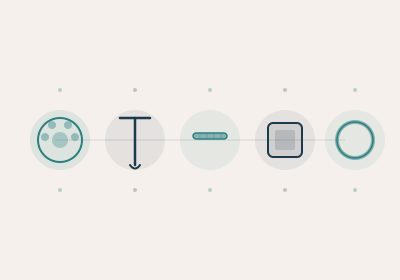
Your options at a glance
Let me walk through the main methods, with their honest pros and cons as I discuss them with my patients:
Combined oral contraceptive pill (COC): Contains oestrogen and a progestogen. Highly effective when taken correctly (over 99%), but real-world effectiveness drops to around 91% because pills get missed. Advantages include cycle regularity, lighter periods, and improvement in acne and PMS. Downsides: the small increased risk of blood clots (particularly in smokers, women with a higher BMI, or those with migraines with aura), potential mood changes, and the need to remember a daily pill. Not suitable for everyone — I always take a careful history before prescribing.
Progesterone-only pill (POP): Contains only a progestogen, no oestrogen. The newer desogestrel POP (such as Cerazette or its generics) suppresses ovulation in most women and has a 12-hour missed-pill window, making it more forgiving than older POPs. Safe for women who cannot take oestrogen — breastfeeding mothers, women with migraines with aura, and those with a history of blood clots. The main downside: unpredictable bleeding patterns, particularly in the first few months.
Hormonal coil (IUS/Mirena): A small T-shaped device placed in the uterus that releases levonorgestrel locally. Lasts 5–8 years depending on the brand. This is one of the most effective contraceptives available (over 99%) and my most frequently recommended method. It dramatically reduces menstrual bleeding — many women have very light or absent periods. Minimal systemic hormonal absorption. Fitting takes a few minutes, and while it can be uncomfortable, most women tolerate it well. Suitable for women of all ages, including those who have never been pregnant.
Copper coil (IUD): A non-hormonal intrauterine device that works by creating an environment toxic to sperm. Lasts 5–10 years. An excellent choice for women who want highly effective, hormone-free contraception. The trade-off: periods may become heavier and more painful, particularly in the first 3–6 months. I always discuss this honestly, because for women who already have heavy periods — including those with conditions like PCOS — the copper coil may not be the best fit.
Implant (Nexplanon): A small rod placed under the skin of the upper arm, lasting 3 years. Over 99% effective. The most common issue is unpredictable bleeding — some women have no periods at all, others experience prolonged spotting. I find this works brilliantly for some women and is intolerable for others. It’s worth trying if the idea of not thinking about contraception for three years appeals to you.
Injection (Depo-Provera): A progesterone injection given every 12–13 weeks. Effective and convenient, but I prescribe it with some caution. Long-term use is associated with a reduction in bone mineral density (which recovers after stopping), potential weight gain, and a delay in return to fertility — sometimes up to a year after the last injection. I tend to reserve this for women who have tried other methods or have specific reasons for preferring it.
Patch and vaginal ring: The patch (Evra) is changed weekly for three weeks, then one week off. The ring (NuvaRing) is inserted vaginally for three weeks, then removed for one week. Both deliver combined hormones and have similar efficacy and side-effect profiles to the combined pill, but without the daily routine. Good options for women who want hormonal contraception but know they’ll forget a daily pill.
Barrier methods (condoms, diaphragm): Condoms remain the only method that protects against sexually transmitted infections, which is why I recommend them in addition to other contraception for anyone with new or multiple partners. As sole contraception, their typical-use failure rate is around 13–18%, which is considerably higher than hormonal methods or coils.
How to choose: the questions I ask
When a woman comes to me for contraceptive advice, I explore several areas before making a recommendation:
- Medical history: Migraines with aura, history of blood clots, breast cancer, liver disease, and BMI all influence which methods are safe. I use the UK Medical Eligibility Criteria (UKMEC) to guide this assessment, as recommended by the Faculty of Sexual & Reproductive Healthcare.
- Lifestyle: Do you travel frequently across time zones? Will you remember a daily pill? How do you feel about a procedure for fitting? Are you in a stable relationship or do you need STI protection? If so, cervical screening is also worth keeping up to date.
- Bleeding preferences: Some women want regular, predictable periods. Others would happily never have a period again. This shapes my recommendation significantly.
- Plans for pregnancy: If you want to conceive within the next year, a long-acting method may not be the most practical choice — though both the implant and coils offer immediate return to fertility upon removal.
- Previous experience: What have you tried? What did you dislike? Your past experience is one of the most useful pieces of information I have.
Switching methods safely
I often see women who want to change their contraception but are nervous about a gap in protection. The good news is that switching can almost always be done seamlessly. The general principle is to start the new method before stopping the old one, or to switch at a specific point in your cycle. For example, you can have a coil fitted while still on the pill, then simply stop taking it. If you’re switching from the injection, timing matters more, and I’ll plan this with you to ensure continuous cover. There is no need for a ‘break’ between methods — that is an old myth that puts women at risk of unintended pregnancy.
Contraception in perimenopause
This is one of the most frequently overlooked areas in women’s health. Women in their 40s often assume they don’t need contraception because their fertility is declining. And yes, fertility does decline — but ovulation can still occur unpredictably, and unintended pregnancy in the perimenopausal years is not rare. I see it in my clinic regularly.
The current guidance is clear: contraception should be continued until one year after your last period if you are over 50, or two years after your last period if you are under 50. The Mirena coil is an excellent perimenopausal option because it provides contraception, manages heavy bleeding (which often worsens in perimenopause), and can serve as the progesterone component of HRT if you also need oestrogen replacement. It’s a genuinely elegant solution for women in this transitional phase.
The combined pill is generally not recommended after 50 (or earlier if you have cardiovascular risk factors), but the progesterone-only pill, implant, and coils remain safe options throughout perimenopause.
Emergency contraception
I want to mention this because many women are uncertain about their options. Emergency contraception is available if a method fails or unprotected sex has occurred. Levonorgestrel (the ‘morning-after pill’) is effective within 72 hours but works best within the first 12 hours. EllaOne (ulipristal acetate) can be taken up to 120 hours (5 days) after unprotected sex and is more effective, particularly on days 3–5. The most effective emergency contraception of all is the copper IUD, which can be fitted up to 5 days after unprotected sex and has a failure rate of less than 1%. If you find yourself needing emergency contraception more than occasionally, that is a signal to revisit your regular method — not a judgment, simply a practical observation.
Common misconceptions
A few myths I encounter repeatedly in practice:
- ‘You need to take a break from the pill every few years.’ No. There is no medical reason for a ‘pill break’. Stopping and restarting actually carries more risk (the VTE risk is highest in the first few months of use) than continuous use.
- ‘The coil is only for women who have had children.’ Completely untrue. Coils can be fitted safely in women who have never been pregnant. The cervix may be slightly narrower, but with an experienced practitioner, fitting is straightforward.
- ‘Hormonal contraception causes infertility.’ It does not. Fertility returns promptly after stopping the pill, removing the implant, or having a coil removed. The only method with a delayed return to fertility is the injection.
- ‘You need a period every month to be healthy.’ A withdrawal bleed on the pill is not a true period — it serves no physiological purpose. Running pill packets together, or using a method that suppresses periods, is safe and increasingly the approach I recommend.
There is no single "best" contraceptive — only the best one for you, right now. A proper consultation should explore your medical history, lifestyle, preferences, and plans before recommending an approach.
Want to discuss your contraceptive options? Book a consultation.
Book NowMedically reviewed by Dr. Victoire Kotur de Castelbajac, Medical Gynaecologist (GMC No. 7982441) — Last reviewed March 2026
Sources & Further Reading
- FSRH Clinical Guidelines — Comprehensive clinical guidelines on all contraceptive methods from the Faculty of Sexual & Reproductive Healthcare
- NHS Contraception Guide — NHS overview of contraceptive options, effectiveness, and how to access them
- NICE NG88: Heavy Menstrual Bleeding — NICE guideline covering assessment and management of heavy periods, including the role of hormonal contraception
- RCOG Patient Information: Contraception After Birth — Royal College of Obstetricians and Gynaecologists guidance on postpartum contraceptive choices